Introduction: Is Traditional PR Truly Dead? (The Nuance Founders Need)
In the dynamic world of business and media, few questions spark as much debate among founders, consultants, and creators as whether "traditional PR" has met its demise. With the rapid acceleration of AI technologies, it's a question that feels more urgent than ever. Is the era of press releases, media kits, and carefully cultivated journalist relationships truly over, replaced by algorithms and automated content generation?
The Hype vs. Reality: Redefining 'Traditional PR'
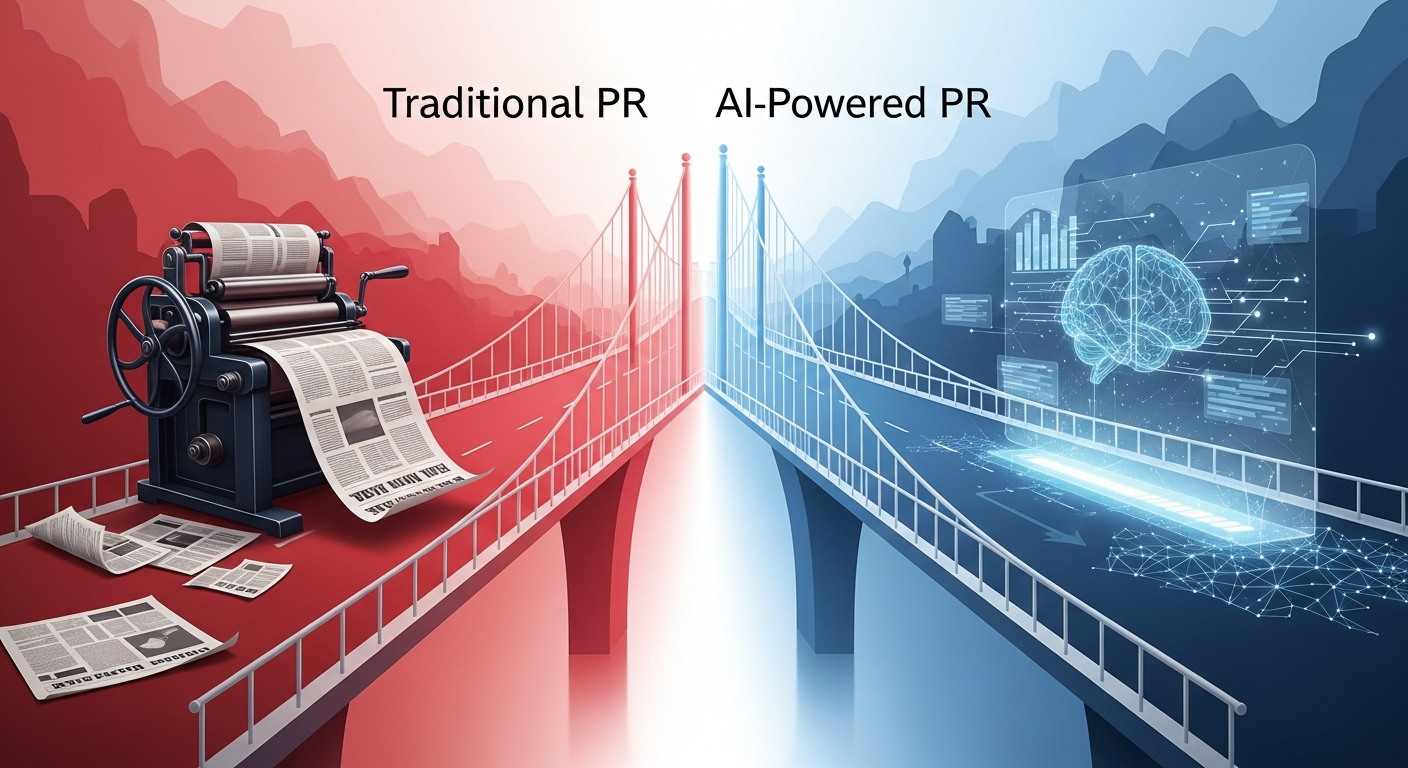
The short answer is: no, not entirely. But it's not a simple 'yes' either. The landscape of public relations is undergoing a profound transformation, certainly, but it's more of an evolution than an extinction event. What many perceive as "traditional PR" – often characterized by a scattergun approach to press releases or an exclusive focus on top-tier media placements – is indeed becoming less effective. The 'spray and pray' method is yielding diminishing returns in a fragmented, personalized media environment.
However, the core tenets of PR – compelling storytelling, building trust, and earning credible visibility – are not just surviving; they're more vital than ever. AI isn't eliminating the need for these; it's changing the tools and tactics we use to achieve them. For founders, understanding this nuance is critical to developing modern media strategies and navigating the evolving PR landscape effectively. For a deeper dive into modern approaches, explore our guide on understanding modern media strategies and the evolving PR landscape for founders.
Why This Question Matters for Your Business
For startup founders, solo consultants, small business owners, and creators, the question of traditional PR's relevance isn't academic. It directly impacts where you invest your time, energy, and limited resources. Misunderstanding the AI impact on PR can lead to missed opportunities or, worse, investing in outdated strategies that don't deliver credible visibility. This post will cut through the noise, offering a practical, founder-friendly perspective on how AI is reshaping PR and how you can harness its power ethically to tell your story and build your brand's reputation.
How AI is Reshaping (Not Replacing) PR for Founders
AI isn't a replacement for human ingenuity, empathy, or strategic thinking in public relations. Instead, it's a powerful co-pilot, an augmentation tool that streamlines processes, uncovers insights, and frees up valuable time for founders to focus on what truly matters: authentic connection and strategic narrative development.
Automation for Efficiency: Research, Drafting, and Monitoring
One of AI's most immediate and beneficial impacts on PR is its ability to automate time-consuming, repetitive tasks. For founders with lean teams or solo operations, this is a game-changer. AI tools can rapidly analyze vast amounts of data, identifying relevant media contacts, trending topics, and potential speaking opportunities far faster than any human could. This means less time spent sifting through databases and more time spent crafting a compelling pitch.
Furthermore, AI can assist in the initial stages of content creation. It can generate drafts of social media posts, article outlines, or even initial press release copy. It's crucial to remember these are drafts – starting points that require a human touch for accuracy, tone, and the unique voice of your brand. AI also excels at media monitoring, tracking mentions of your brand, competitors, and industry trends across countless online sources, providing real-time insights that inform your strategy.
Data-Driven Insights for Smarter Strategy
Gone are the days of purely gut-instinct PR. AI brings a new level of data-driven precision to public relations. By analyzing audience demographics, engagement patterns, and content performance, AI can help founders understand what messages resonate most effectively with their target audiences. This allows for more targeted campaigns, optimized content, and a clearer understanding of ROI. Instead of guessing, founders can make informed decisions based on actionable data, refining their PR strategy for maximum impact.
Personalized Outreach: A Cautionary Tale for AI Use
While AI can assist with personalized outreach by suggesting relevant angles or tailoring message elements, it comes with a significant cautionary tale: authenticity. The temptation to automate personalized emails en masse can lead to generic, spammy communication that damages your credibility. Journalists and influencers are adept at spotting AI-generated, insincere outreach. The goal of AI in outreach should be to enhance human connection, not to replace it. Use AI to identify the right contacts and provide data-backed insights for a compelling pitch, but let your human voice and genuine interest drive the final interaction. Ethical AI use means prioritizing genuine relationship building over mere volume.
The Unshakeable Foundation: Authentic Storytelling & Credibility in the AI Era
Amidst all the technological advancements, the bedrock of effective public relations remains unchanged: authentic storytelling and unwavering credibility. AI can amplify these, but it cannot create them. For founders, this is where your unique value truly shines.
Why Your Founder Story Still Dominates
Your journey, your vision, your challenges, and your triumphs – these form the core of your founder story, and it is arguably your most powerful asset. AI can help you structure narratives or suggest compelling language, but it cannot replicate the lived experience, passion, and unique perspective that only you possess. In an increasingly commoditized world, your authentic story is what differentiates you, building an emotional connection with your audience and the media. Learn more about leveraging your authentic founder story as a key marketing asset.
Building Trust, Not Just Buzz: The Credibility Imperative
The internet is awash with information, and distinguishing truth from noise has never been harder. This context makes credibility not just a nice-to-have, but an absolute imperative for founders. AI can generate content quickly, but it cannot imbue that content with trust. Trust is earned through consistent, transparent, and authentic communication. It's built on verifiable facts, genuine testimonials, and a track record of delivering on promises.
For founders, this means focusing on interview-led content where your expertise and personality can shine through. It means ensuring that every piece of communication reflects your values and stands up to scrutiny. Building powerful online credibility doesn't require a full PR team; it requires a commitment to truth and authenticity. Discover how founders build powerful online credibility without a full PR team.
The Human Element: What AI Can't Replicate
While AI can mimic human language and even generate creative ideas, it lacks true understanding, empathy, and the ability to form genuine human connections. It cannot experience the world, feel emotions, or develop the nuanced intuition that guides strategic PR decisions. A founder's passion, their ability to inspire, to connect on a human level – these are irreplaceable. These are the elements that transform a product into a movement, a company into a community. AI serves best when it empowers the human element, allowing founders to spend more time on strategic thinking, relationship building, and expressing their unique vision.
Strategic Content Repurposing & Distribution with AI Assistance
One of the most significant advantages AI offers to founders is its ability to maximize the value of every piece of content, especially interview-led insights. This is where the efficiency of AI truly empowers lean teams to achieve broad visibility.
Maximizing Every Interview: From Raw Answers to Press-Ready Assets
Founders often have a wealth of knowledge and insights, but capturing, refining, and distributing these can be a monumental task. This is precisely where AI-powered PR interviews shine. Imagine a conversation where you share your expertise, and then AI transforms those raw answers into a suite of polished, press-ready assets. This could include compelling quotes for media pitches, structured answers for an FAQ section, or even the foundational content for a thought leadership article.
Instead of spending hours transcribing and manually crafting content from interviews, AI can help extract key themes, summarize points, and even suggest different angles for various publications or platforms. This dramatically reduces the time and effort required to turn your valuable insights into tangible, shareable content.
The Power of Repurposed Content for LinkedIn and Beyond
The modern media landscape demands presence across multiple platforms. What works as a quote in a press release might need to be repackaged as a concise LinkedIn post, a snippet for Twitter, or an expanded section in a blog article. AI tools excel at this content transformation. They can take a core message and adapt its length, tone, and format to suit the specific requirements of different channels. This is particularly powerful for LinkedIn, where founders can establish strong personal brands and industry thought leadership by consistently sharing valuable insights derived from their interviews.
By effectively repurposing content, founders ensure that their message reaches a wider audience without the need to create entirely new content from scratch for each platform. It's about working smarter, not harder, to amplify your reach and reinforce your expertise.
Smart Distribution for Wider Reach Without a Full Team
Beyond content creation, AI can assist in smarter distribution. While it won't guarantee media placement (nothing can), it can help identify the most relevant platforms and audiences for your repurposed content. This could mean suggesting optimal posting times, identifying influential hashtags, or even analyzing which content formats perform best on specific channels. For busy founders, this means less guesswork and more strategic deployment of their content assets. To discover how AI-powered PR interviews can streamline your content creation and empower you to scale your visibility, visit ToniPR.
Navigating the Ethical Landscape: Responsible AI in PR for Founders
As AI becomes more integrated into PR workflows, the ethical implications are paramount. For founders, maintaining trust and credibility is non-negotiable, making responsible AI use a critical component of any modern PR strategy.
Transparency and Disclosure: A New Standard
The rise of AI-generated content necessitates a new standard of transparency. Founders must be clear about when and how AI has been used in their public communications. Whether it's drafting initial content, analyzing data, or assisting with outreach, disclosure builds trust. Hiding AI's role can lead to accusations of deception and erode credibility. The goal is to use AI as an assistant, enhancing human efforts, not to create a false impression of original human creation where it doesn't exist.
Avoiding Misinformation, Bias, and 'Hallucinations'
AI models are trained on vast datasets, and if those datasets contain biases or inaccuracies, the AI's output will reflect them. Founders must be vigilant in reviewing and verifying any AI-generated content for misinformation, factual errors, or inherent biases. AI models can also "hallucinate" – generating plausible-sounding but entirely false information. This makes human oversight indispensable. Every piece of AI-assisted content must pass a rigorous fact-check and alignment with your brand's values before publication to prevent damage to your reputation.
Data Privacy and Security Considerations
Using AI tools often involves inputting sensitive information about your company, products, and target audience. Founders must carefully consider the data privacy and security implications of the AI platforms they choose. Understand how your data is used, stored, and protected. Prioritize providers with robust security measures and clear privacy policies. Protecting proprietary information and respecting audience data privacy are not just legal requirements but fundamental ethical obligations that underpin credible PR practices.
For a comprehensive framework on ethical AI integration in PR, the Public Relations Society of America offers crucial guidance. We strongly recommend reviewing the PRSA AI Ethics Guidelines for Public Relations Practitioners to ensure your PR strategy remains both innovative and responsible.
DIY PR vs. Agency: Empowering Founders with AI Tools
For many founders, the choice between managing PR in-house or hiring an agency has always been a significant one, often boiling down to budget versus desired impact. AI is shifting this dynamic, making credible, impactful DIY PR more accessible than ever before.
Making Strategic Choices for Your Business
Hiring a traditional PR agency can be a substantial investment, often out of reach for early-stage startups, solo consultants, or small business owners. While agencies offer expertise and connections, their cost often means founders must prioritize which stories get told, if any. AI tools provide an alternative, enabling founders to execute many PR functions themselves, often with surprising effectiveness and at a fraction of the cost.
The decision no longer has to be an all-or-nothing proposition. Founders can strategically leverage AI for tasks like media research, content drafting, and performance analysis, reserving human effort for high-value activities like relationship building and strategic planning. This hybrid approach offers flexibility and cost-efficiency, allowing founders to scale their PR efforts as their business grows. For a detailed guide on this decision, read our post on deciding between a DIY PR approach and hiring a traditional agency.
The Rise of the 'AI-Augmented' Founder
We are entering an era where founders aren't just tech-savvy; they are 'AI-augmented.' This means they harness intelligent tools to enhance their capabilities across all business functions, including PR. An AI-augmented founder can conduct sophisticated market research, craft targeted messages, and monitor media mentions with a speed and precision previously only available to large agencies. This democratization of PR tools means that a compelling story, well-articulated and strategically distributed, can now gain traction