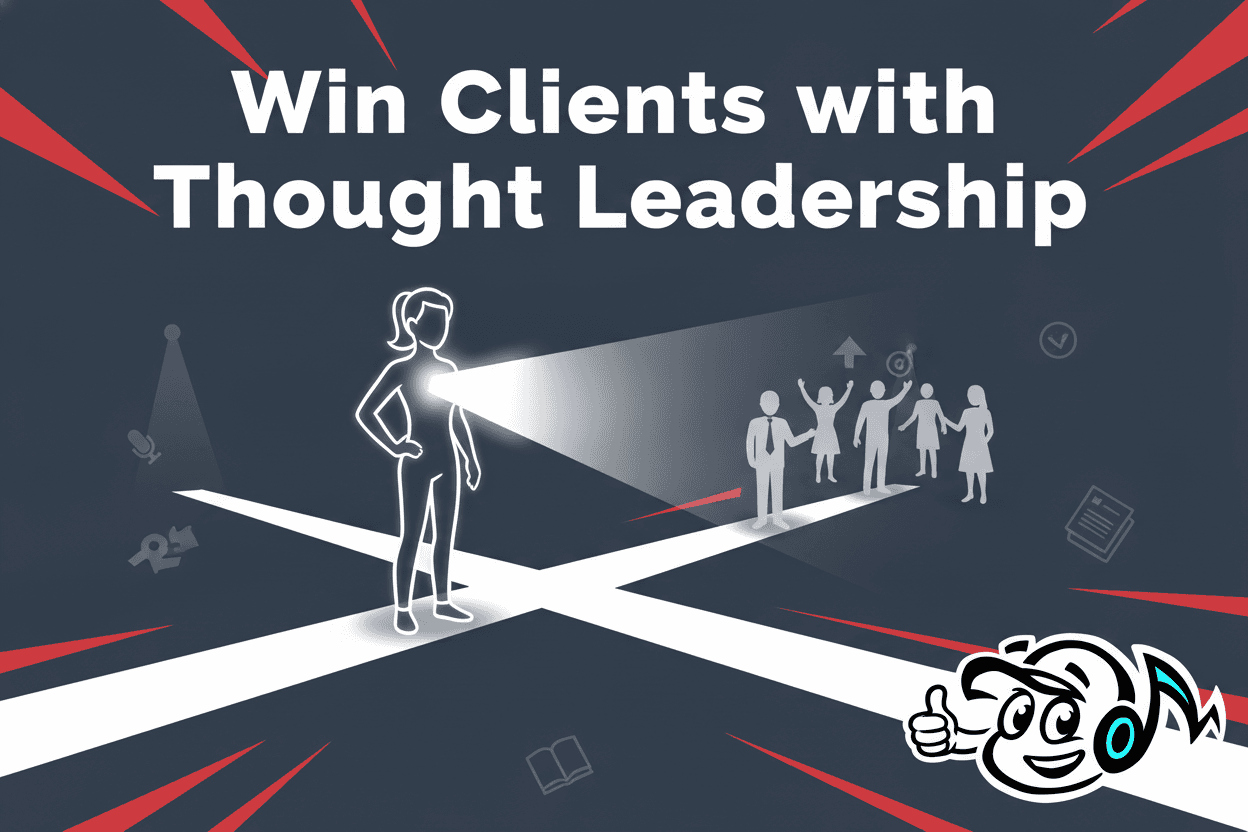
How Consultants Can Use Thought Leadership to Win Clients
In the competitive landscape of consulting, simply offering services isn't enough to stand out. Solo consultants, independent professionals, and small consulting firm owners face the constant challenge of demonstrating their unique value and attracting high-quality clients. Traditional marketing often falls short, leading to a constant scramble for new business. This is where thought leadership for consultants becomes not just an advantage, but a necessity.
Thought leadership isn't about being the loudest voice in the room; it's about being the most insightful. It's about consistently sharing valuable perspectives that educate, challenge, and inspire your target audience, positioning you as an indispensable expert. For consultants, this translates directly into enhanced credibility, stronger client relationships, and a more sustainable path to client acquisition.
This guide will walk you through how to cultivate and leverage your unique expertise into powerful thought leadership, using an interview-led approach to streamline your content creation and amplify your impact. We'll explore strategies for building genuine authority, repurposing your insights effectively, and attracting ideal clients who truly value what you bring to the table.
What is Thought Leadership for Consultants (and Why It Matters)
At its core, thought leadership is the act of establishing yourself as an authority in your field by sharing original insights and demonstrating a deep understanding of your niche. For consultants, this isn't just about showing off your knowledge; it's about solving your prospective clients' problems before they even formally engage you.
Defining Authentic Authority in Consulting
Authentic authority isn't something you can buy or fake. It's earned through experience, consistent learning, and the courage to articulate your unique perspective. For consultants, defining authentic authority means identifying the specific challenges you excel at solving, the methodologies you champion, and the future trends you anticipate. It's about moving beyond simply listing your services to clearly articulating your philosophy and approach to complex problems. This genuine expertise helps you move beyond traditional marketing tactics to establish genuine expertise that resonates deeply with your audience.
When you define your authentic authority, you attract clients who value your insights and seek specific solutions, not just another vendor. This strategic positioning allows you to command respect and trust, which are invaluable assets in the consulting world.
The Consultant's Challenge: Standing Out in a Crowded Market
The consulting market is saturated. Every day, new independent professionals and boutique firms emerge, all vying for the same pool of clients. Without a clear differentiator, consultants often find themselves competing on price, which is a race to the bottom. The challenge isn't just about being good at what you do; it's about being perceived as uniquely capable and insightful. Thought leadership provides that crucial differentiation.
By consistently sharing your unique perspectives, you carve out a distinct niche and build a reputation that precedes you. This helps consultants overcome the noise and establish a clear position in their chosen domain.
Shifting Your Focus: From Selling Services to Solving Problems
The traditional sales approach for consultants often involves pitching services and hoping a client sees the fit. Thought leadership flips this model. Instead of selling services, you focus on solving problems through your content. You address common pain points, offer innovative solutions, and guide your audience toward better outcomes, all before a sales conversation even begins.
This shift in focus allows you to build trust and credibility long before a formal proposal is even considered. When potential clients consume your insightful content, they begin to see you as a trusted advisor, not just another salesperson. This pre-establishes your value and makes the eventual sales conversation much more natural and effective, leading to stronger client relationships built on mutual respect and understanding.
- Move beyond traditional marketing tactics to establish genuine expertise.
- Attract clients who value your insights and seek specific solutions.
- Build trust and credibility long before a formal proposal is even considered.
Capturing Your Expertise: The Interview-Led Approach to Thought Leadership
Many consultants struggle to translate their vast knowledge and experience into compelling content. They know their stuff, but writing articulate blog posts, articles, or social media updates feels like another project entirely. This is where an interview-led approach to thought leadership strategy can be a game-changer.
Unlocking Unique Insights Through Structured Conversation
Your brain is a treasure trove of insights, but sometimes it takes a structured conversation to unlock them. An interview format, whether self-directed or guided by a platform like ToniPR, allows you to articulate your thoughts naturally, as you would in a client meeting or a professional discussion. This process can help you uncover nuances, anecdotes, and perspectives that might not emerge during a typical writing session. It's about drawing out the expertise that's already within you, making it accessible and actionable for your audience.
By engaging in structured conversations, you can systematically extract and refine your specialized knowledge. This not only makes content creation more efficient but also ensures that the output is authentically yours, reflecting your true voice and experience.
Developing a Powerful and Consistent Public Voice
A distinctive public voice is crucial for any thought leader. It's how your audience recognizes you, connects with your message, and differentiates you from others in your field. An interview-led approach helps you develop this voice by capturing your natural speaking patterns, your unique phrasing, and the conviction in your arguments. This raw material can then be refined into compelling narratives that truly resonate with your target clients.
Tools like ToniPR are specifically designed to help consultants develop a powerful and consistent public voice. By answering PR-style interview questions, you transform your direct answers into clear, compelling narratives that resonate with your target audience, solidifying your position as a credible authority.
The Credibility Advantage of Original, Authentic Content
In an era of recycled content and generic advice, originality stands out. Thought leadership thrives on fresh perspectives and genuine insights derived from your unique experience. When you share content that truly comes from your own thought process, rather than repackaged information, your credibility skyrockets. Clients seek out consultants who offer a distinct point of view, not just a rehash of common knowledge.
Using an interview-led process ensures your content is original and authentic, directly reflecting your genuine perspective and experience. This approach helps you differentiate yourself with content that isn't just informative, but truly insightful and personal, making your voice unmistakable in the crowded marketplace.
- Utilize tools like ToniPR to systematically extract and refine your specialized knowledge.
- Transform your direct answers into clear, compelling narratives that resonate.
- Differentiate yourself with content that reflects your genuine perspective and experience, not just recycled ideas.
Strategic Content Repurposing: Maximizing Your Thought Leadership Reach
One of the most powerful aspects of an interview-led content strategy is the ability to repurpose a single core piece of content into multiple formats. This approach maximizes your effort, ensures consistency across platforms, and significantly amplifies your thought leadership reach without requiring you to create entirely new content from scratch for every channel. This is central to an effective content marketing for consultants strategy.
From a Single Interview to Multi-Platform Content Assets
Imagine conducting one in-depth interview about a key industry trend or a common client challenge. From that single foundational conversation, you can generate a wealth of content: a detailed blog post, a series of LinkedIn updates, impactful quotes for social media graphics, a script for a short video, or even a segment for a podcast. Each piece, while distinct in format, carries the same core message and reinforces your expertise. This efficiency is critical for busy consultants.
Learn to transform one core interview into diverse content formats: articles, social media posts, quotes, and more, ensuring your valuable insights reach your audience wherever they are.
Enhancing Your LinkedIn Visibility and Attracting Clients
For consultants, LinkedIn is arguably the most critical platform for professional visibility and client acquisition. Repurposing your thought leadership content specifically for LinkedIn can dramatically enhance your presence. This might mean sharing an excerpt from an article with a personal reflection, posting a key statistic with your commentary, or engaging in discussions around topics you've covered. Consistent, valuable contributions on LinkedIn position you as a go-to expert in your network.
To truly enhance your LinkedIn visibility and attract clients, optimize your presence on professional platforms. Check out our guide on LinkedIn Visibility: Strategies for Consultants and Freelancers to learn more about leveraging this powerful platform.
Leveraging a Newsletter for Consistent Expertise and Engagement
While social media offers broad reach, a personal newsletter provides a direct, intimate channel to your most engaged audience. It allows you to deliver your thought leadership insights directly to their inbox, fostering a deeper connection and consistent engagement. Your newsletter can feature exclusive content, summarize recent blog posts, share personal reflections, or offer early access to new ideas, solidifying your role as a trusted advisor.
Establishing a direct channel to consistently share valuable insights and maintain top-of-mind awareness is crucial. Explore whether a newsletter is right for your consulting business and how to leverage it for consistent expertise and engagement.
Building a Strategic Personal Brand Aligned with Your Message
Every piece of thought leadership content you publish contributes to your personal brand. By strategically repurposing content, you ensure that your brand message is consistent, coherent, and reinforced across all channels. This integrated approach helps you build a strong, recognizable identity that is synonymous with your expertise, making it easier for ideal clients to find and connect with you.
To ensure all your content reinforces a cohesive and strong personal brand, it's essential to have a strategic approach. Read our guide on Building your personal brand as a consultant: A strategic guide to align your message with your brand.
- Learn to transform one core interview into diverse content formats: articles, social media posts, quotes, and more.
- Optimize your presence on professional platforms to connect with ideal clients.
- Establish a direct channel to consistently share valuable insights and maintain top-of-mind awareness.
- Ensure all your content reinforces a cohesive and strong personal brand.
Building Genuine Credibility and Attracting Ideal Clients

The ultimate goal of thought leadership for consultants is not just visibility, but also to build genuine credibility that naturally attracts ideal clients. This process is a marathon, not a sprint, and it's built on a foundation of ethics, consistency, and a deep understanding of your audience's needs.
Ethical Thought Leadership: Value Over Hype
In an age of endless digital noise, genuine value cuts through. Ethical thought leadership is about providing authentic, actionable insights that truly help your audience, without resorting to exaggerated claims or empty promises. It's about sharing your expertise generously and transparently, rather than just promoting your services. This builds a foundation of trust that no amount of marketing hype can replicate.
Focus on providing authentic, actionable insights rather than exaggerated claims. When your content consistently delivers real value, your audience will naturally gravitate towards you, recognizing you as a reliable source of information and solutions.
The Long Game: Why Consistency Trumps Virality
The allure of viral content is strong, but for consultants, sustained consistency is far more effective. A single viral post might generate a momentary spike in attention, but a consistent stream of valuable thought leadership content builds lasting trust and authority over time. It demonstrates commitment, expertise, and reliability – qualities that are highly valued by prospective clients. The "long game" approach allows you to patiently cultivate a loyal audience and a strong reputation.
Understand that sustained, valuable contributions build lasting trust and authority. This consistent effort ensures you remain top-of-mind for your audience and reinforces your position as an expert in your field.
Attracting Inbound Leads That Align with Your Expertise
One of the most significant benefits of effective thought leadership is the shift from outbound selling to inbound attraction. When you consistently publish insightful content, you naturally draw in leads who are already interested in the problems you solve and the solutions you offer. These inbound leads are often higher quality, more qualified, and more receptive to your services because they've already pre-vetted you through your content.
Position your content to naturally draw in clients who genuinely need your specific solutions and expertise. This strategic approach to client acquisition means less time chasing leads and more time engaging with potential clients who are already predisposed to trust and value your work.
- Focus on providing authentic, actionable insights rather than exaggerated claims.
- Understand that sustained, valuable contributions build lasting trust and authority.
- Position your content to naturally draw in clients who genuinely need your specific solutions and expertise.
Measuring the Impact of Your Thought Leadership Efforts
While thought leadership isn't about immediate sales metrics, it's crucial to understand how to measure its effectiveness. For consultants, this means looking beyond superficial numbers and focusing on indicators that truly reflect growing influence and client interest. This helps refine your thought leadership strategy for continuous improvement.
Beyond Vanity Metrics: What to Track for Real Results
Likes, shares, and superficial engagement numbers are often called "vanity metrics" because they look good but don't always translate into business outcomes. For thought leadership, focus on deeper engagement: comments that ask insightful questions, direct messages seeking advice, increased website traffic to specific articles, and how long people are spending consuming your content. These indicators suggest genuine interest and a desire to learn more from you.
Shift focus from likes and shares to lead quality, depth of engagement, and direct inquiries. These metrics provide a more accurate picture of how your thought leadership is impacting your business and attracting potential clients.
Client Conversations as a Key Indicator of Success
Ultimately, the most significant measure of your thought leadership's impact for consultant client acquisition is its influence on client conversations. Are prospective clients referencing your articles or posts during initial calls? Are they coming to you with a clearer understanding of their problems and your potential solutions? Are sales cycles shortening because trust has already been established through your content? These qualitative shifts are powerful signs that your thought leadership is working.
Recognize how your content influences and facilitates more meaningful sales discussions. When your thought leadership content pre-qualifies and educates potential clients, your conversations become more productive and focused on solutions.
Iterative Improvement: Refining Your Strategy Based on Engagement
Thought leadership is not a set-it-and-forget-it strategy. It requires continuous observation and adaptation. Pay attention to which topics resonate most deeply with your audience, which formats generate the most engagement, and what questions your content sparks. Use this feedback to refine your content calendar, adjust your tone, and deepen your insights. This iterative process ensures your thought leadership remains relevant, impactful, and aligned with your audience's evolving needs.
Continuously adapt and enhance your thought leadership approach based on audience feedback and tangible business outcomes. This commitment to iterative improvement ensures your strategy remains dynamic and effective in attracting and retaining ideal clients.
- Shift focus from likes and shares to lead quality, depth of engagement, and direct inquiries.
- Recognize how your content influences and facilitates more meaningful sales discussions.
- Continuously adapt and enhance your thought leadership approach based on audience feedback and tangible business outcomes.
Frequently Asked Questions
How long does it take for thought leadership to generate clients for consultants?
Thought leadership is a long-term strategy focused on building sustainable authority and trust, not a quick lead generation tactic. For consultants, it typically takes 6 to 18 months of consistent effort to see measurable results in terms of inbound leads and new client acquisition. The initial phase focuses on building an audience and establishing credibility. Over time, as your body of work grows and your reputation solidifies, you'll notice more qualified leads reaching out, often referencing specific insights you've shared. It's an investment in your future pipeline, yielding compounding returns rather than instant gratification.
What's the difference between thought leadership and content marketing for consultants?
Content marketing is a broad strategy that encompasses creating and distributing valuable, relevant, and consistent content to attract and retain a clearly defined audience. It includes various content types like blog posts, videos, infographics, and social media updates, often focused on SEO and lead nurturing. Thought leadership, on the other hand, is a specific *type* of content marketing that goes beyond basic information or aggregation. It focuses on sharing original insights, unique perspectives, and innovative solutions that challenge existing norms and push the industry forward. While all thought leadership is content marketing, not all content marketing is thought leadership. For consultants, thought leadership aims to position you as an authoritative expert, while general content marketing might aim for broader awareness or traffic.
Do I need a large audience or a massive following to be an effective thought leader?
No, a large audience or massive following is not a prerequisite for effective thought leadership. For consultants, the quality and relevance of your audience far outweigh its size. It's more impactful to have a smaller, highly engaged audience of potential ideal clients who deeply resonate with your specific expertise than a vast, general following that may never convert. Focusing on niche topics and delivering profound insights to a targeted group will build genuine influence and attract high-value clients more effectively than aiming for viral fame. Your goal is to be a leader for your specific market, not necessarily for the entire world.
How can I avoid sounding 'salesy' when sharing thought leadership content?
To avoid sounding 'salesy,' shift your focus from pitching services to providing genuine value and solving problems. Your thought leadership content should educate, inform, challenge, or inspire your audience without directly asking for their business in every piece. Here are key strategies:
- Lead with Value: Share actionable insights, frameworks, and perspectives that genuinely help your audience, even if they never become a client.
- Focus on Problems, Not Products: Discuss common challenges your target clients face and offer potential solutions or new ways of thinking, rather than highlighting your specific service offerings.
- Share Your Expertise Generously: Be open about your knowledge and experience. The more you give, the more trust you build.
- Incorporate Storytelling: Use case studies (anonymized if necessary), anecdotes, and personal experiences to illustrate your points, making your content more relatable and less like a sales pitch.
- Soft Calls to Action: Instead of "Buy my service," suggest "Learn more about X topic," "Download this guide," or "Join the conversation." Let the value of your content naturally lead to further engagement.
By prioritizing authentic insight and helpfulness, your thought leadership will naturally attract clients who are already pre-sold on your expertise.
Building a powerful thought leadership presence is a strategic imperative for consultants seeking to differentiate themselves and attract high-value clients. It's about consistently sharing your unique insights, building genuine credibility, and transforming your expertise into a magnet for the right opportunities. With an interview-led approach, you can streamline this process, turning your deep knowledge into a steady stream of valuable content.
Don't let your valuable expertise remain trapped in your head. Start transforming your insights into influential content that builds your reputation and attracts your ideal clients. Explore how ToniPR can help you capture your unique perspective and convert it into press-ready outputs, enabling you to become the recognized authority in your field.