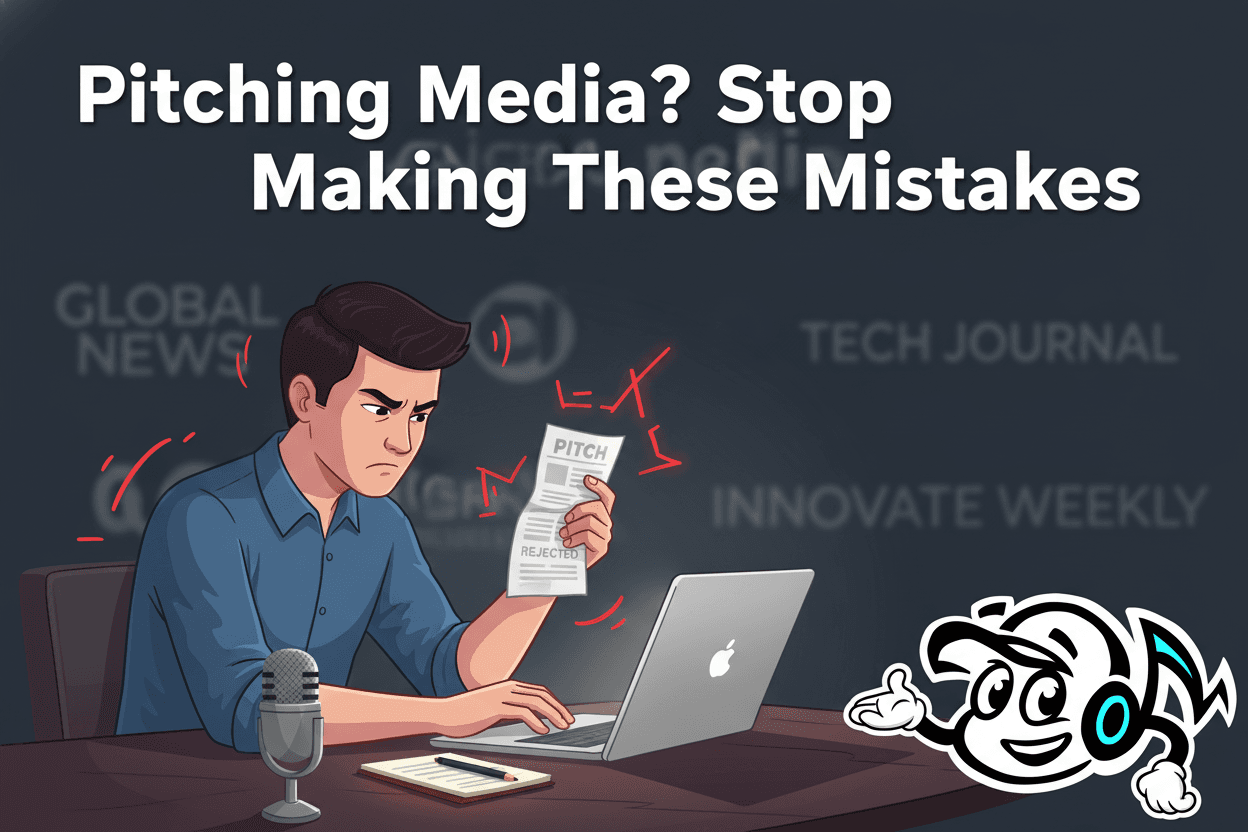
7 Common Mistakes Founders Make When Pitching Media
Securing earned media coverage can be a game-changer for founders, solo consultants, and small business owners. It offers unparalleled credibility, boosts visibility, and builds trust with your audience. Yet, for every success story, countless pitches fall flat. Why? Often, it's not a lack of a good story, but a misstep in how that story is presented and to whom.
Introduction: From Missed Opportunities to Meaningful Media Coverage
The Founder's PR Challenge: Earning Credible Visibility
As a founder, you're juggling a thousand tasks. Building a product, acquiring customers, managing your team – the list is endless. Adding "become a PR expert" to that list feels daunting. But the reality is, credible visibility isn't just a nice-to-have; it's a strategic imperative. Earned media, unlike paid advertising, comes with an inherent stamp of approval from a trusted third party. This can significantly impact your brand's reputation, attract investors, and drive customer acquisition.
However, navigating the complex world of media outreach without a dedicated PR team can feel like an uphill battle. Many founders approach it with enthusiasm but lack the strategic framework that journalists expect. They want to share their passion, but often miss the mark on what makes a story truly newsworthy to an external audience.
Why Most Pitches Fall Flat: Beyond the 'Send' Button
You've poured your heart and soul into your venture, and you believe your story deserves to be told. So, you hit 'send' on a pitch, perhaps to a dozen journalists, and then... silence. This is a common scenario. The truth is, most pitches fail not because the story isn't valuable, but because of fundamental PR pitching mistakes in their conception and delivery. From targeting the wrong person to failing to articulate a clear, interview-ready narrative, these blunders can quickly relegate your email to the digital graveyard.
At ToniPR, we believe in an ethical, strategic approach to media outreach, centered around interview-led storytelling. By understanding and avoiding these common media pitching mistakes, you can dramatically improve your chances of securing meaningful coverage and transforming missed opportunities into compelling press.
Mistake 1: Pitching Irrelevant Stories or the Wrong Journalist
Ignoring the Beat: Why Research is Non-Negotiable
One of the most frequent media pitching mistakes founders make is sending a blanket email to every journalist they can find. This "spray and pray" approach is a surefire way to annoy reporters and damage your credibility. Journalists are specialists; they cover specific "beats" or topics. A tech reporter isn't interested in your new restaurant opening, and a lifestyle blogger won't care about your latest B2B SaaS update.
Before you even think about drafting a pitch, invest time in meticulous research. Read a journalist's recent articles, follow them on social media (especially LinkedIn), and understand the publication's audience. What kind of stories do they typically cover? What angles resonate with their readership? This isn't just about finding their email; it's about understanding their professional world and identifying how your story genuinely fits within it. Building genuine relationships with journalists, rooted in respect for their work and time, is a cornerstone of effective media relations. As the PRSA emphasizes, true media relations best practices involve consistent, ethical engagement that goes beyond transactional pitches. The Public Relations Society of America (PRSA) offers authoritative insights into building and maintaining genuine relationships with journalists, emphasizing trust, transparency, and consistent engagement beyond transactional pitching.
The 'Me, Me, Me' Trap: Shifting Focus to the Audience
Founders are passionate about their companies, and rightly so. However, pitches often become overly focused on the product or the founder's journey, rather than the impact or relevance to the journalist's audience. Journalists don't write stories to promote your business; they write stories to inform, entertain, or engage their readers. Your pitch needs to answer the critical question: "Why should my readers care about this?"
Shift your perspective. Instead of saying, "My company launched X," frame it as, "X solves Y problem for Z demographic, which is a growing concern for your readers." Highlight trends, offer unique data points, or present a fresh perspective on a current issue. Your company might be the vehicle, but the story's true value lies in its broader implications or human interest.
No Clear News Hook: Making it Easy for Journalists to Say 'No'
A news hook is the element that makes your story timely, relevant, and compelling right now. Without it, your pitch is just information, not news. Common PR mistakes for founders include sending out announcements without a clear connection to current events, industry trends, or significant milestones.
Is your story tied to a recent report, a national holiday, a cultural phenomenon, or a major industry shift? Does it offer a solution to a widely discussed problem? Can you provide expert commentary on a breaking news story? A strong news hook provides journalists with an immediate reason to cover your story, making their job easier and significantly increasing your chances of success. A structured, interview-led story helps you align your narrative with these journalistic interests, ensuring your message is not just heard, but considered newsworthy.
Mistake 2: Crafting Generic, Non-Personalized Outreach
The Mass Email Blunder: Why 'Spray and Pray' Fails
Following on from the previous point, sending identical pitches to dozens or hundreds of journalists is one of the most egregious media pitching mistakes. Journalists receive hundreds of emails daily, and they can spot a mass email a mile away. It signals a lack of effort, a disrespect for their time, and an assumption that their publication is just another generic outlet.
Personalization goes far beyond simply inserting a journalist's name. It means referencing a specific article they wrote, mentioning a recent social media post, or explaining precisely why you believe your story is a perfect fit for their particular beat and audience. This demonstrates that you've done your homework and genuinely value their work, not just their contact information. For more insights on this, explore other critical errors to avoid when pitching press.
Weak Subject Lines That Get Deleted: Grabbing Attention Ethically
Your subject line is your pitch's gatekeeper. If it doesn't grab attention, your meticulously crafted email will never be opened. Weak, generic, or overly promotional subject lines are common PR mistakes for founders. Avoid clickbait, all caps, or vague phrases like "Exciting News!" or "Press Release."
Instead, aim for clarity, conciseness, and intrigue. Highlight the news hook or the unique value proposition immediately. Examples: "Exclusive: How [Your Company] Solves [Problem X] for [Audience Y]," or "Expert Commentary: [Your Name] on [Industry Trend]." Keep it under 60 characters and make it relevant to the journalist's beat. This ethical approach to grabbing attention is key to effective startup media outreach.
Forgetting the Human Element: Beyond the Template
Even with personalization, pitches can sometimes feel stiff and templated. Remember that you're communicating with a human being who is likely overwhelmed and under pressure. A pitch should be professional but also convey a genuine, respectful tone. Avoid corporate jargon and overly formal language. Be direct, polite, and confident.
Consider starting with a brief, genuine compliment about their recent work that relates to your pitch. Conclude with a clear, concise request and an offer to provide more information or an interview. This human touch can make your pitch stand out from the robotic, templated emails journalists often receive. It's about building a connection, however brief, that might lead to a longer-term professional relationship.
Mistake 3: Lacking a Compelling, Interview-Ready Narrative

Burying the Lede: Getting to the Point Quickly
The "lede" is the most important part of your story, usually the first sentence or paragraph, that summarizes the core news. Many founders bury their lede, starting with lengthy introductions about their company history before getting to the actual news. Journalists are busy; they need to understand the gist of your story within the first few seconds of reading your email. This is a classic of common PR blunders.
Get straight to the point. What is the news? Why is it significant? Who is it important to? Answer these questions upfront, then provide supporting details. Think of your pitch as a mini news article: headline first, then the most critical information, followed by context. This concise approach is vital for successful how to pitch media effectively.
Over-Reliance on Jargon: Speaking in Plain English
Your industry might be steeped in technical terms and acronyms, but journalists (and their audience) likely aren't. Over-reliance on jargon is a major barrier to communication and a common media pitching mistake. It makes your story inaccessible, complicated, and frankly, boring to anyone outside your niche.
Translate your complex ideas into plain, engaging English. Focus on the impact and benefits rather than the intricate mechanics. If you must use a technical term, explain it clearly and concisely. The goal is to make your story easy to understand and compelling for a broad audience. This is where the power of interview-led storytelling shines – by structuring your thoughts and answers in a conversational way, you naturally simplify complex ideas into accessible, authentic narratives. Learn more about storytelling for entrepreneurs and engaging your audience authentically.
No Clear Call to Action for the Journalist: What Do You Want Them to Do?
Your pitch should always conclude with a clear, specific call to action. Do you want them to schedule an interview? Review your product? Consider you for an upcoming story? Many founders forget this crucial step, leaving the journalist wondering what the next step is. This ambiguity is a key factor in many PR mistakes for founders.
Make it easy for the journalist to understand what you're asking for and how you can help them. Offer to provide additional resources, high-resolution images, or a quick chat. A well-articulated request not only guides the journalist but also demonstrates your professionalism and preparedness. By presenting an interview-ready narrative, you make it easy for a journalist to envision an article or segment, streamlining their process and increasing your chances of coverage.
Mistake 4: Poor Timing and Improper Follow-Up
Pitching Too Early or Too Late: Understanding Editorial Calendars
Timing is everything in media relations. Pitching too early (before your product is ready or your news is truly concrete) can lead to premature announcements or a lack of detail. Pitching too late (after a trend has passed or a competitor has already covered similar ground) means you've missed your window. Understanding a publication's editorial calendar and news cycles is crucial for effective how to pitch media effectively. Major announcements often require weeks, if not months, of lead time, especially for print publications or broadcast segments.
Monitor news trends, industry events, and even seasonal cycles. If your story ties into a specific holiday, awareness month, or major conference, plan your outreach well in advance. Consider also that daily news cycles are fast-paced, so breaking news commentary needs to be pitched almost immediately. To help you with this, consider our guide on when founders should start pitching media for an optimal timeline.
The 'Ghosting' or Over-Pestering Problem: Finding the Right Balance
Once you've sent your initial pitch, the waiting game begins. One common media pitching mistake is either "ghosting" (not following up at all) or "over-pestering" (sending too many follow-ups too frequently). Both can be detrimental.
A strategic follow-up is essential. Generally, one polite, concise follow-up email a few days to a week after your initial pitch is appropriate. Reiterate your main point, offer any new relevant information, and gently remind them of your availability. If you don't hear back after a second touch, it's usually best to let that particular pitch go and pivot to a different angle or journalist. Respect for a journalist's time is paramount. Patience and persistence are key, but always balanced with professional courtesy. This is a critical aspect of avoiding common PR blunders.
Not Respecting Deadlines: A Journalist's Worst Nightmare
Journalists operate under strict deadlines. If they express interest in your story and ask for information or an interview by a certain time, meeting that deadline is non-negotiable. Failing to respond promptly or providing requested materials late is a surefire way to lose an opportunity and damage your reputation. This is one of the quickest ways to fall into the category of PR mistakes for founders.
Be prepared to act quickly. Have your assets ready (as discussed in the next section), know your key messages, and be available for interviews. If you absolutely cannot meet a deadline, communicate this immediately and offer a realistic alternative. Proactive communication and reliability are highly valued in the fast-paced media world.
Mistake 5: Neglecting Pre-Pitch Credibility & Resources
No Media Kit or Essential Assets: Making a Journalist's Job Harder
A journalist's job is to gather information and present it clearly to their audience. If your pitch sparks their interest, their next step is to find supporting materials. If you don't have these readily available, you're creating extra work for them, which often means they'll move on to an easier story. A lack of essential resources is a common media pitching mistake.
A well-organized media kit (or press kit) is invaluable. It should include: a compelling company overview, high-resolution logos and product images, founder bios and headshots, key statistics or data, recent press releases, and contact information. Making these assets easily accessible (e.g., via a link to a dedicated press page on your website) shows professionalism and preparedness, significantly increasing your appeal to busy reporters. This is a foundational step in how to pitch media effectively.
Undefined Founder Expertise: Why Should They Listen to You?
Journalists seek credible sources. As a founder, you are often the best spokesperson for your company, but your expertise needs to be clearly defined and showcased. If your pitch doesn't articulate why you are an authority on your subject matter, or why your insights are valuable, journalists will be hesitant to feature you. This is a critical element of avoiding common PR blunders.
Build your founder credibility and thought leadership before you start pitching. This involves regularly sharing insights on LinkedIn, contributing to industry forums, speaking at relevant events, or publishing guest posts. When you pitch, briefly highlight your relevant experience or unique perspective that makes you a valuable source. For a deeper dive, read our guide on how to build founder credibility before your first pitch.
Unprepared for the 'What's Next?': Seizing Opportunities
You've sent a great pitch, the journalist is interested, and they want to schedule an interview or request more details. Now what? Many founders, caught off guard by success, aren't fully prepared for the next steps. This unpreparedness can lead to fumbling questions, inconsistent messaging, or delays that jeopardize the opportunity. Being ready to seize opportunities is key to effective startup media outreach.
Anticipate the journalist's questions and have your key messages rehearsed. Understand your company's narrative, your unique selling propositions, and any data points you want to share. A structured interview process, like that offered by ToniPR, can ensure you have all your assets and story points ready and accessible, making you confident and articulate when the opportunity arises. This proactive preparation turns potential PR mistakes for founders into powerful opportunities.
Navigating the media landscape can seem complex, but by understanding and avoiding these common media pitching mistakes, founders, consultants, and SMBs can significantly improve their chances of securing valuable earned media. The key lies in strategic research, personalization, clear storytelling, respectful timing, and thorough preparation. Remember, the goal isn't just to get mentioned, but to build lasting credibility and truly connect with your audience through meaningful, interview-led narratives.
ToniPR is designed to empower you in this journey, helping you transform your insights into press-ready content and ensuring you're always prepared for that crucial media moment. Our AI-powered interviews streamline the process, helping you articulate your story compellingly and consistently, ready for any journalist's inquiry.
Frequently Asked Questions
How often should I follow up with a journalist after pitching?
A general best practice is to send one polite, concise follow-up email a few business days (3-5 days) after your initial pitch. This gives the journalist time to review your original email. If you still don't hear back, you might consider a second and final follow-up about a week later, perhaps offering a fresh angle or additional information. After two follow-ups without a response, it's typically best to assume they're not interested in that particular story or timing and pivot to other journalists or story ideas. Always prioritize respecting their time and inbox.
What's the most effective way to identify the right journalists for my story?
The most effective way is thorough research. Start by identifying publications that cover your industry or relevant topics. Then, dive into their archives to see which specific journalists regularly write about subjects related to your story. Look for their beat, recent articles, and even their social media (LinkedIn, X/Twitter) to understand their interests and writing style. Tools like Cision, Muck Rack, or even advanced Google searches can help, but manual research and reading their work are irreplaceable. Focus on quality over quantity – a highly targeted pitch to one relevant journalist is far better than a mass email to many. This diligence helps you avoid crucial media pitching mistakes.
Is a formal press kit essential before I start pitching media?
Yes, a formal or at least a well-prepared digital press kit is highly advisable, if not essential. While you might not need a physical folder, having a dedicated press page on your website with easily downloadable assets is crucial. This should include high-resolution logos, founder headshots and bios, company overview, key facts/stats, recent press releases, and relevant product images or videos. A journalist who is interested in your story will often immediately look for these resources, and having them readily available makes their job much easier, increasing your chances of coverage. It's a foundational step to build founder credibility before your first pitch.
How can ToniPR help founders and consultants improve their media outreach?
ToniPR empowers founders, consultants, SMBs, and creators to improve their media outreach by streamlining the content creation process. Instead of struggling to write press-ready content from scratch, ToniPR uses AI-powered interviews to guide you through PR-style questions. You record your authentic answers, and ToniPR then transforms them into various press-ready outputs, such as quotes, LinkedIn posts, articles, and bios. This ensures you have compelling, consistent, and interview-ready narratives at your fingertips, making it easier to craft personalized pitches, build credibility, and provide journalists with the exact information they need, when they need it. It helps you avoid common PR mistakes for founders by ensuring you're always prepared with high-quality, repurposable content. Explore how ToniPR can streamline your PR content creation with AI interviews.